Mediterranean macaques are special animals in the genus Macaque. Their tails are generally short, and many people like them. Of course, there are also many friends who don't know much about them. In this regard, the editor specially collected some relevant information, let's take a look~
I. Basic information
Chinese name: Mediterranean Macaque
Latin name: Macaca sylvanus
Alternative names: Barbary macaque, old man, Gibraltar ape
Kingdom: Animalia
Phylum: Chordate
Subphylum: Vertebrate subphylum
Class: Mammalia
Subclass: Eustoma
Order: Primates
Suborder: Cynonasium
Family: Monkey family
Subfamily: Rhesus macaque Family
Genus: Rhesus macaque
Species: Mediterranean Macaque
Named and dated: Linnaeus, 1758
II. Appearance characteristics
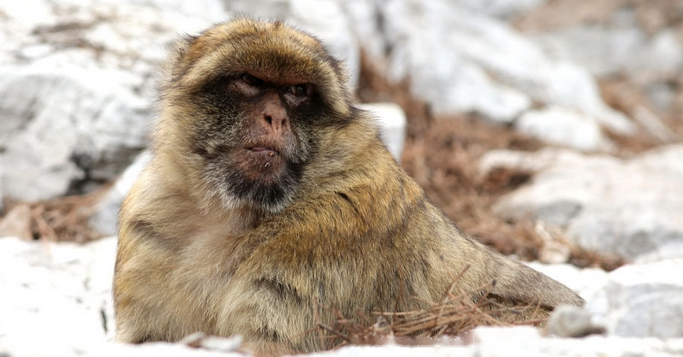
The head of a male Mediterranean macaque is about 55-70 cm long and weighs about 7-19 kg; the female head is about 45-55 cm long , weighing about 5-8 kg.
The whole body coat of the Mediterranean macaque is usually yellow-grey to a darker taupe; the fur on the chest and abdomen is much thinner than on the rest of the body, and the cheeks are usually dark pink, but occasionally Slightly dark pink.
III. Distribution range
1. Origin: Algeria and Morocco.
2. Regional extinction: Tunisia.
3. Import: Gibraltar.
IV. Living habits
Mediterranean macaques live in groups to a certain extent, each group has 12-60 members, usually an older one. A female Mediterranean macaque is the leader.
Mediterranean macaques have a mixed diet, mainly on grass, leaves, grass roots, fruits, young leaves, bark and roots, and occasionally on invertebrates and insects.
V. Reproduction
The mating season of Mediterranean macaques is usually from November to March of the following year; female monkeys can give birth to one litter every two years. The gestation period is approximately 147-192 days.
VI. Protection level
Mediterranean macaques are protected animals and have been included in several protection lists, as follows:
1, World Conservation Union (IUCN) 2008 Red List of Threatened Species ver 3.1 - Endangered (EN).
2, Washington Convention CITES Appendix II class protected animals.
Today's sharing is over here~ Friends who like Mediterranean macaques quickly bookmark this article! In addition, if there is anything you don't understand, please leave a message below.

![[Original] Sharing of popular science knowledge of ringed map turtles](/static/img/11249/11249_1.jpg)