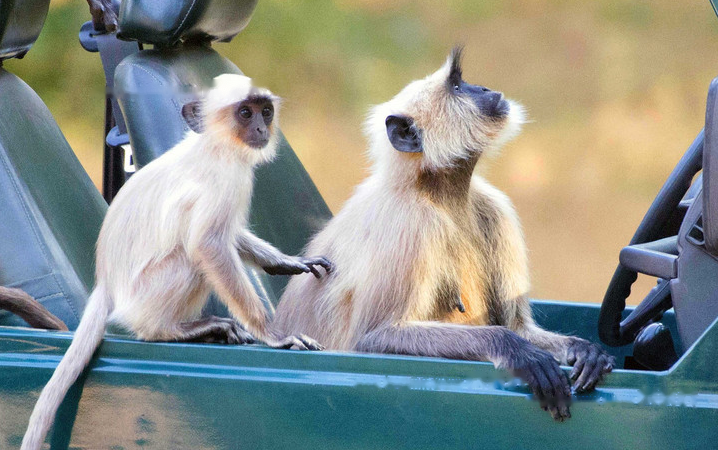
The Indian grey langur, as its name suggests, is a primate native to India. The Indian grey langur is also known as the sacred monkey or sacred monkey by the Indians. Hanuman, the monkey king created by the Indian grey langur, is the protagonist in a famous local myth. Like the Monkey King in the mythical story Journey to the West, he is also very powerful, with boundless mana, good at changing, and able to fly through the clouds.
I. Basic information
【Chinese name】Indian grey langur
【 Aliases: Northern Plains Gray Langur, Bengal Long-tailed Langur, Hanuman Langur
【English name】Northern Plains Gray Langur, Bengal Hanuman Langur
【Latin name】Semnopithecus entellus
【Kingdom】Animal Kingdom
【Department】Chordates
【Subphylum】Vertebrate Subphylum
【Class ] Mammalia
[Subclass] Eustoma
[Order] Primates
[Suborder] Anthropomorphis
【Family】Monkey family
【genus】grey langur
[species] Indian grey langur
II. Morphological characteristics
1. Body size: Indian grey langur is about 58.5-64 cm in length, 9.9-13 kg in weight, tail is more than 100 cm long, cheek hairs and eyebrows developed. Named for body length or tail length.
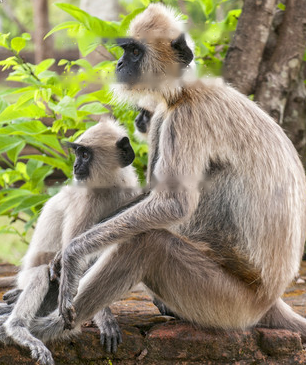
2. Body color: The body hair of the Indian grey langur is mainly brown and gray, with red on the back and white fur on the ventral surface. There are some grayish-white hairs on the forehead, radiating in a spiral, black feet, hands, face and ears, and a ring of white hairs on the cheeks. Crown hair. The eyebrows grow forward and are also very long. There are white hairs on the head, face, chin, and throat, and his appearance is quite unrestrained. The skin is pale at birth, but turns black before three months; the coat color is also different from that of adulthood, being brown-black, becoming light gray at two to five months of age, then gradually turning yellow-brown, and turning to gray-yellow-brown in adulthood .
III. Distribution and Habits
1. Distribution: Indian grey langur originated in India, and later also Introduced to India's neighboring country Bangladesh. The species is extremely adaptable, from the arid regions of the desert fringes of Rajasthan, India, to the tropical evergreen rainforests of the Western Ghats, from 100 meters above sea level to 4,270 meters above sea level in the Himalayas, and from -7?C in winter to 46 It survives the scorching heat of ?C.
2. Social characteristics: Indian grey langurs usually like to form a small group of more than ten or a large group of nearly 100 to move together, and spend 5 hours a day to groom each other.
3. Feeding habits: Indian grey langur mostly forages in the morning and dusk, mainly eating various leaves, branches and buds, accounting for about 54% of the total food. 5%, and fruits account for about 37%. Indian grey langurs in different places can go months without water during the dry season because they drink their own urine to quench their thirst in addition to getting water from plants.
Four. Reproductive status
The gestation period of female Indian grey langur is about 168-196 days, each litter produces 1 cub, and the lactation period is 2 year. Indian grey langurs inhabit high mountains. Females give birth in April each year. Before the arrival of the cold winter, the cubs have grown up and are basically able to live independently, while Indian grey langurs living in tropical areas are born in four seasons throughout the year. are fertile. Newborn cubs are dark brown with pink face and face. Unlike adults, they turn black after 3 months. Females reach sexual maturity at 4 years old, while males reach sexual maturity at 6 years old.
V. Population status
Indian grey langurs are deeply admired by Indians for religious reasons, so the population is stable and has no survival crisis. species. Walking on the streets of India, you can see the existence of Indian grey langurs everywhere. If you don't give them something to eat, you will even be besieged!
The introduction to the knowledge of Indian grey langur is here. If you have any questions, you can leave a message and discuss in the comment area.

![[Original] Sharing of popular science knowledge of ringed map turtles](/static/img/11249/11249_1.jpg)