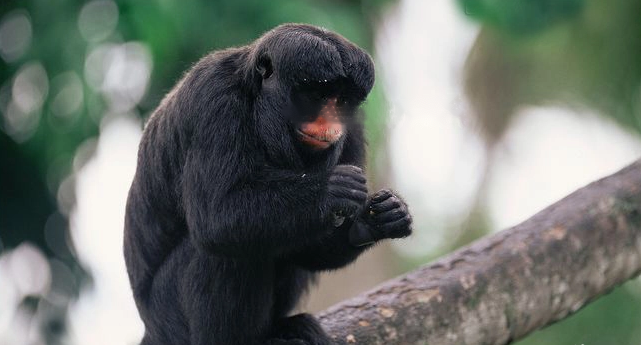
The white-nosed plexus monkey is a species of capuchin monkey, named for the white patches on its big nose. Wild white-nosed plexus monkeys live in tropical rain forests, and it is difficult for people to capture them. The following is a small series to give you the knowledge of white-nosed bush-tailed monkeys! Friends, take good notes~
I. Basic information
Chinese name: White-nosed plexus monkey
Latin name: Chiropotes albinasus
English Name: White-nosed Saki
Kingdom: Animalia
phylum: Chordate
Class: Mammalia
Order: Primates
Family: Capuchinidae
Species: White-nosed Phyllostachys
Named: I. Geoffroy and Deville, 1848
II. Morphological characteristics
The white-nosed plexus monkey is a medium-sized species, with a body length of 43-70 cm, a female weight of 4.3 kg, and a male weight of 6.7 kg. The fur on the limbs, belly and tail is black.
III. Living habits
The white-nosed bush-tailed monkeys form a group of 12-30 monkeys, mainly active in the middle canopy, and often show acrobatic movements , such as jumping and soaring. Females are sexually mature around age 4, have a gestation period of 172 days, and produce one offspring approximately every two years. Female monkeys will nurse their offspring for about 6 months. Adult females remain in the group, while males are driven away.
The white-nosed bush-tailed monkey's diet consists mainly of fruits, seeds and leaves, but also eats insects.
When the white-nosed plexus monkey encounters a leopard, it will send out the sound of Pu Yas to call the police; and when an eagle appears in the sky, it will call the police with a sound of Hiks similar to a cough. Moreover, they can also express the two pronunciations pujas and hiks in different times and combinations to express different meanings, so they are regarded as the first outside humans to be found to use sentences. language-communicating animals.
In the 2008 Red List of Primates, the white-nosed macaque was listed as an endangered species. At this stage, we need to increase the awareness of wildlife protection, so that more animals can continue to live on the earth.

![[Original] Sharing of popular science knowledge of ringed map turtles](/static/img/11249/11249_1.jpg)