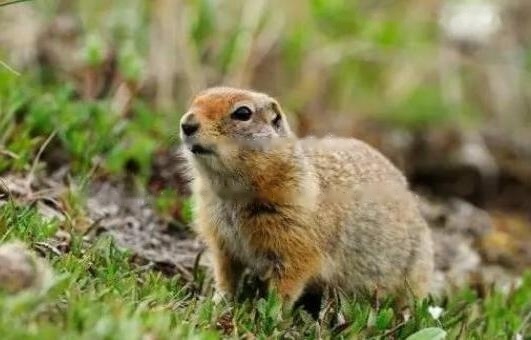
The Koryaksky arctic ground squirrel has a head and body length of 21.5-25 cm, a tail length of 7.5-5 cm, and a weight of 635-700 grams. It is closer to the groundhog in blood, and is similar in size to the common squirrel, with a flat top and a small tail.
The coat is yellow with black and brown with white spots. This species molts twice a year and is usually more reddish-brown and softer in color as winter approaches, and gray-brown in spring. Will stand up, standing about 40 cm in height.
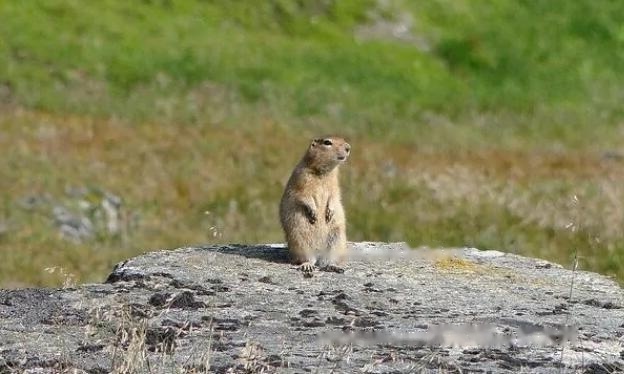
The claws are small and pointed. The nose and eyes are black, and the nose and nearby parts protrude forward. The molars (including premolars) are 5/4 on both sides of the jaw, there are 5 upper molars, and there is no skin wing between the front and rear limbs. It is active during the day, most active in the early morning, and molts every spring and autumn. Litters 2 to 3 times a year, usually more in April and June, with 4 to 6 litter each time.
Koryak arctic ground squirrels mainly live on the ground and live in burrows; they are numerous and like to live together in groups, which is relatively common. Mainly feed on plants, sometimes also eat some insects, carrion or other small animals. Feed on pastures, tundra plants, seeds and fruits in summer to increase body fat to prepare for hibernation. They have the habit of storing food for overwintering. Like squirrels, they will use cheek pouches to transport food to cave tunnels for storage until new ones. Vegetation grows. It enters a hibernation state during the winter, lining its burrows with lichens, grass blades and musk ox hair. During hibernation, their brain and core temperatures can drop above freezing, and their heartbeats drop. The temperature of the colon and blood cools to below freezing. Body temperature decreased to -2.9°C (average -3°), the lowest known in mammals in natural posture.
Distribution range
Distributed in northeastern Asia of Russia, eastern Siberia, Koryak Mountains and Kamchatka Peninsula.
Protection level
Included in the World Conservation Union (IUCN) 2008 Red List of Threatened Species ver 3.1 - Low Risk (LC).

![[Original] Sharing of popular science knowledge of ringed map turtles](/static/img/11249/11249_1.jpg)