The big-eared sand lizard runs very fast, and when it encounters danger, it quickly burrows into the sand dunes and disappears. When being pursued, it often swings its body against the ground, digs the soil quickly, and buries itself in the sand quickly.
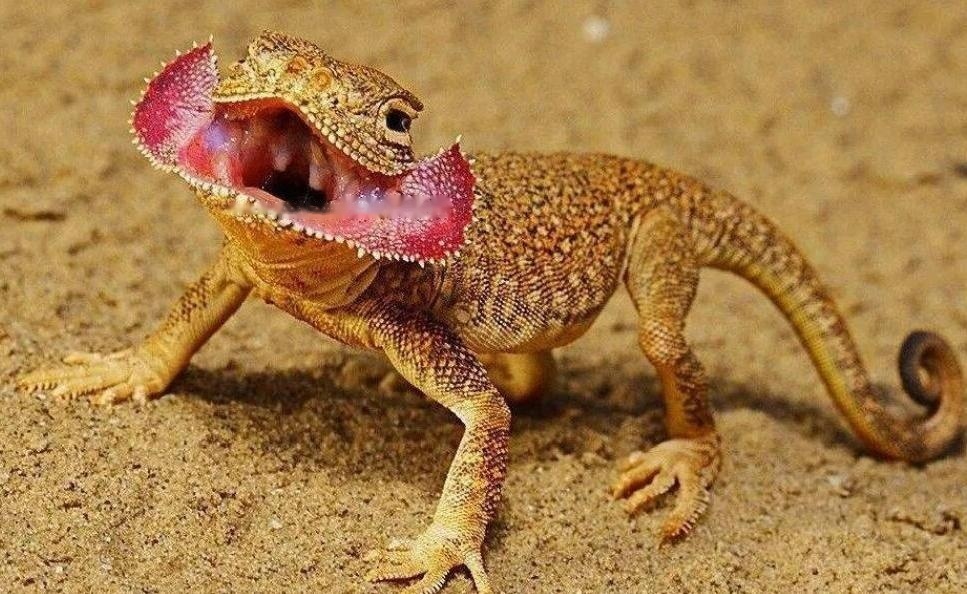
The ear-like skin folds of the big-eared sand lizard have the function of assisting attack and predation. When it is angry, attacking or preparing to escape, the skin folds open, revealing the flesh-red big ears, showing a fierce attitude, and keeps going. The ground flaps, making a wheezing sound to intimidate the other party. The tunnel is straight and long, up to 70-80 cm, but it is shallower from the ground, the hole is large, more than 30 mm wide, and the end of the hole does not expand.
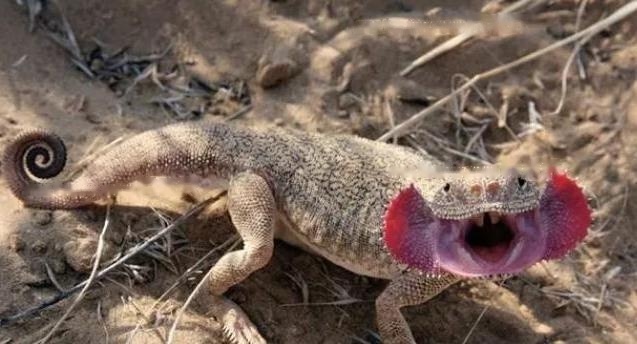
The main food of the big-eared sand lizard includes ants, spiders, locusts, coleopteran insects and their larvae, etc. In addition, small plant fragments are also found in the stomach. Large-eared sand lizards inhabit semi-fixed dunes, often burrowing under sparse small shrubs.
Large-eared sand lizards are large, with a total length of about 150 mm. There are ear-shaped skinfolds at the corners of the mouth. The back is covered with strong scaly scales of the same size. The ventral surface of the tail is white and black at the base, but the young lizards are orange at the base and black at the end. The main difference between the central subspecies and the named subspecies is: the body is large, and the tail is about the same length as the head and body or slightly shorter.
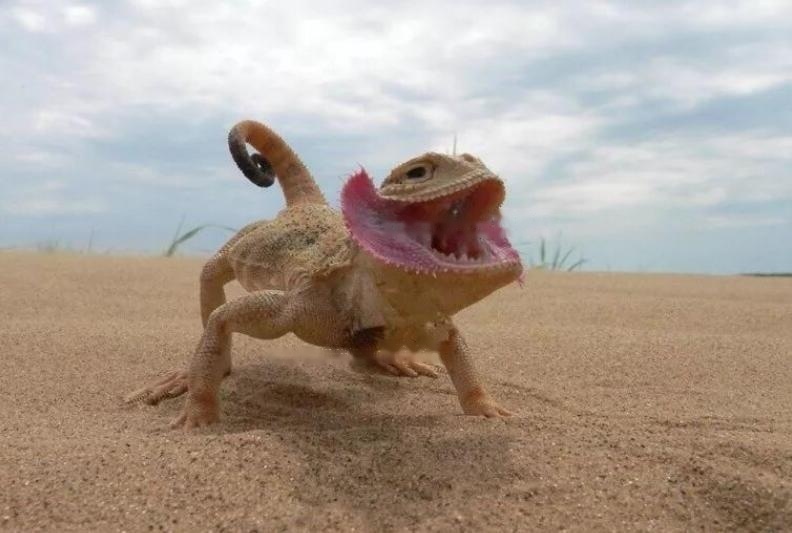
The large-eared sand lizard is the largest of the sand lizards, and it is also a typical desert lizard species distributed from Central Asia to northwestern China. When angry, attacking, or preparing to escape, the flesh-red ears will be exposed, and they will keep flapping and making a huhu sound to intimidate the other party. The main food is insects and their larvae.
The large-eared sand lizard is distributed in Afghanistan, Iran, Kazakhstan, Kyrgyzstan, Turkmenistan, Ukraine, Belarus, Turkey, and Xinjiang in mainland China. It is common in deserts and inhabits semi-fixed dunes. It has been included in the List of Beneficial or Important Economic and Scientific Research Terrestrial Wild Animals Protected by the State.

![[Original] Sharing of popular science knowledge of ringed map turtles](/static/img/11249/11249_1.jpg)