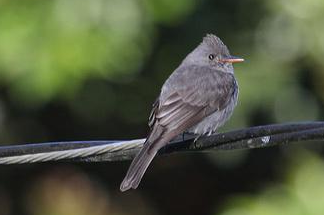
On March 28, in Balinzuo Banner, Inner Mongolia Autonomous Region, several big birds circled in the air in the Ulanba National Nature Reserve. Sun Haiqing, a 53-year-old policeman on horseback, held up his binoculars in amazement. He had been in this forest since childhood. Growing up, it was the first time he saw such a large bird.
Before taking a few more glances, he and his colleagues threw their binoculars around the big bird to be alert for the presence of poachers. This is the 23rd year that Sun Haiqing has guarded the Wulanba National Nature Reserve, and the second year that he has been patrolling on horseback.
Ulanba National Nature Reserve has a total area of 80,878 hectares, with dense forests, vast grasslands, and vertical streams. There are a large number of rare and endangered wild animals and plants under national key protection. It is a transitional zone of forests, grassland vegetation and rare wild animals. The main protected nature reserve.
Illegal grazing, poaching, and digging of medicinal materials often occur in the reserve, but the reserve is mainly primary forest and primary secondary forest, and motor vehicles cannot enter. In order not to damage the grasslands and to solve the difficulties of management, protection and banning, in 2020, the Environmental Food and Drug Investigation Brigade of the Bahrain Zuoqi Public Security Bureau formed a mounted police team composed of 6 people to carry out patrol and security according to local conditions, effectively protecting the natural environment. ecological environment of the protected area.
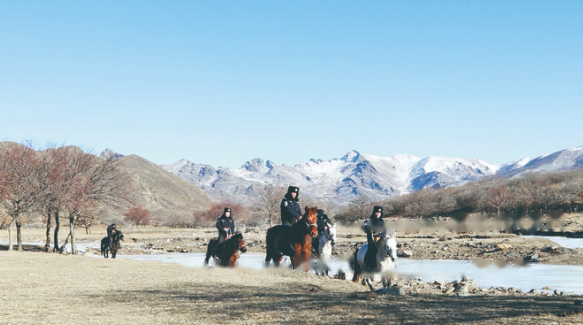
In the past two years, 6 people and 6 horses have traveled through the tops of the mountains and between the forests and seas to rescue injured wild animals and battle wits with poachers and loggers.
According to Sun Haiqing, during a patrol, the mounted police team saw through the binoculars that someone was stealing medicinal materials on the mountain. The six people immediately divided into two teams. Captured by thieves. Poachers have strong anti-investigation capabilities. Several times our mounted police team saw them through binoculars. By the time they arrived, they had already fled. Sun Haiqing said unwillingly. Although the Mounted Police failed to catch them, they played a great deterrent effect. The phenomenon of poaching became less and less, and the horseback patron saint became famous locally.
Not only patrolling the mountains, but also going deep into the surrounding farmers and herdsmen to carry out propaganda and raise their awareness of ecological protection. Today, herdsmen consciously do not graze in the reserve, and they will report to the Mounted Police as soon as they encounter wild animals and poachers who need rescue.
“The altitude here is high, and you have to wear cotton-padded clothes for mountain patrols in summer. In winter, the minimum temperature is more than minus 40 degrees Celsius. Walking on the mountain road against the wind, people and horses are shivering from the cold.” Sun Haiqing said, especially after the heavy snow , The ground is covered with snow, the horses are deep in the woods and the other is shallow. Sometimes when one foot is in the air, people will fall off the horse. Injuries are common, so when patrolling the mountains, they all carry their medical kits with them.
In recent years, the vegetation recovery in the reserve has been getting better and better. Roe deer and red deer have changed from one or two to flocks. There are more and more unnamed birds. These changes are also caused by the Mounted Police. A credit.

![[Original] Sharing of popular science knowledge of ringed map turtles](/static/img/11249/11249_1.jpg)