The white-necked long-tailed pheasant is a special bird in my country. It is included in the list of China's national key protected wild animals and is a national first-class protected bird. It is mainly distributed in the mountains and forests of Jiangxi, Anhui, Fujian and other places south of the Yangtze River. . It is timid but very alert, and few have seen it for what it is. In the past few days, infrared cameras in Wuyishan National Park and Junzifeng National Nature Reserve in Fujian have accidentally recorded their figures.
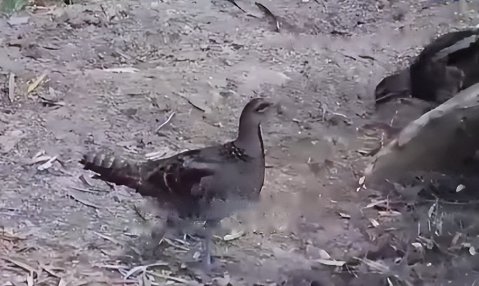
The infrared camera of Junzifeng National Nature Reserve recorded the picture at the end of March. There are four white-necked long-tailed pheasants in the picture. Among them, the male bird is standing on the branch. Its head is gray-brown, its face is bright red, its upper back, chest and wings are maroon, and its upper back and wings are all brown. There is a wide white band, which is more eye-catching. The other three in the clearing are females, their feathers are mainly tan, and they are pacing leisurely around the males. At this time, an uninvited guest came down from the mountain, with a red crown and white feathers. It is a national second-class protected animal, the white pheasant. The white pheasant walked straight to the tree trunk, jumped into the air, and seized the territory of the male white-necked long-tailed pheasant. According to experts, under normal circumstances, white-necked long-tailed pheasants and white pheasants will quickly avoid other animals when they encounter other animals. This time they appeared in the same frame and coexisted peacefully, which is very rare.
Coincidentally, in the core area of Wuyishan National Park these two days, the staff were recycling When the infrared camera was used, the figure of the white-necked long-tailed pheasant foraging was also found.
According to the relevant person in charge of the Scientific Research and Monitoring Center of Wuyi Mountain National Park, the temperature continues to rise in April, everything recovers in spring, and animal activities are active, so the probability of photographing wild animals in Wuyi Mountain is higher.
According to the staff of Wuyishan National Park, with the continuous increase of ecological protection in the past ten years, the staff has used scientific research and monitoring facilities to monitor the water, gas, soil, carbon cycle, flora and fauna in the park. and other ecological and environmental elements, and conduct comprehensive ecological monitoring. By the end of 2021, the deployment of 680 infrared cameras has been completed, covering the entire park. Grid monitoring will be used to assist the investigation of wildlife resources and improve the management and protection capabilities of the national park.

![[Original] Sharing of popular science knowledge of ringed map turtles](/static/img/11249/11249_1.jpg)